Trust and regulation
No Australian local licence was verified for Alawin in the Australian Communications and Media Authority’s register of licensed interactive gambling providers. That matters because ACMA says the Interactive Gambling Act 2001 prohibits providers from offering certain interactive gambling services to people in Australia, including online casinos. The same regulator maintains a public register for licensed Australian interactive wagering services. Alawin’s Australia-facing casino access and the absence of an Alawin entry in that register should therefore be treated as separate facts from the existence of the website itself.
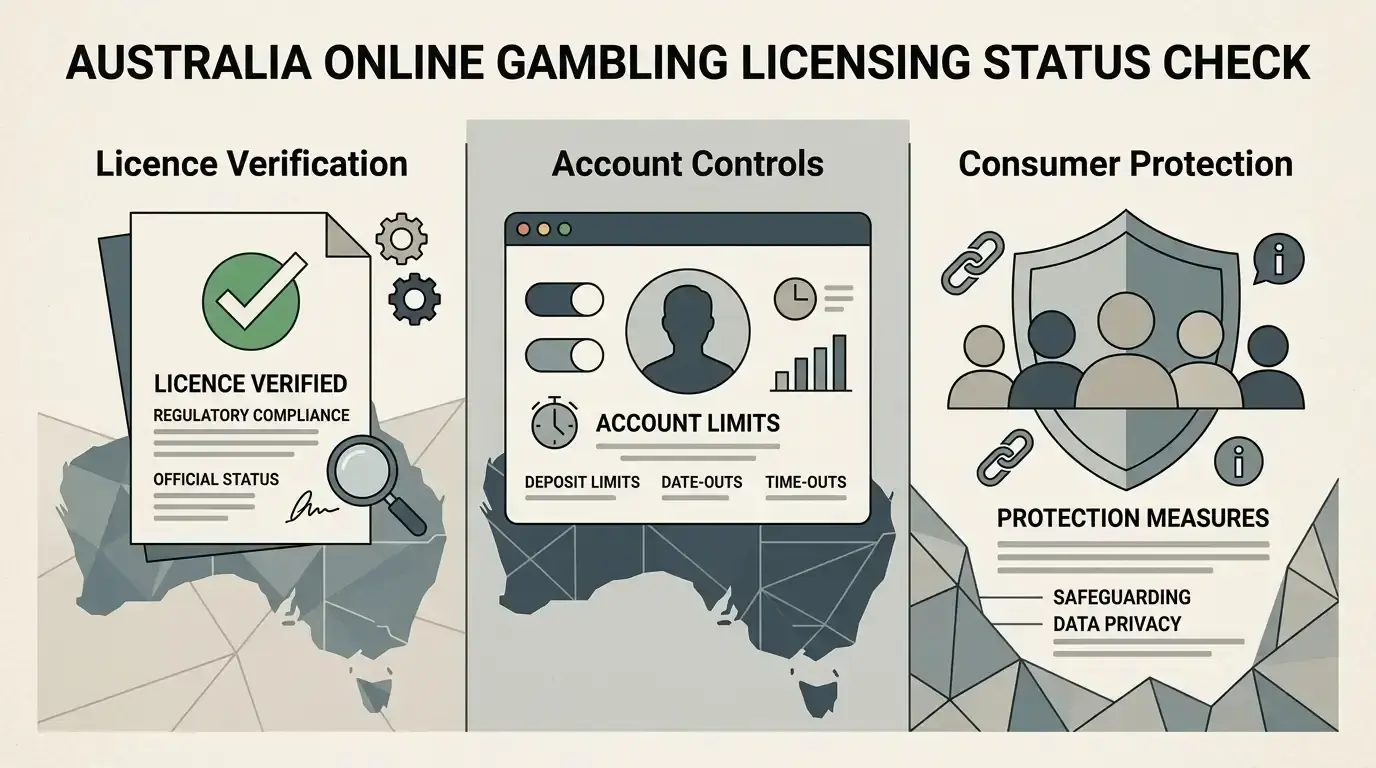
A one-word “safe” or “unsafe” label would hide important distinctions. Trust is better assessed by separating local licensing, the legal status of the product being offered, account-control terms, payment and KYC rules, support access and responsible-gambling tools. For a broader brand overview, start with the main Alawin Australia page. For detailed legislation and enforcement context, use the Australian gambling rules.
What the ACMA register does and does not show
ACMA tells consumers to check its register of licensed interactive gambling providers when assessing an online wagering service. The register lists trading names, licence holders, URLs and licensing authorities for services licensed to provide regulated interactive wagering in Australia. A register entry is therefore evidence of a local wagering licence within that framework.
Our current check did not find Alawin in that register. The correct conclusion is limited: no Australian local licence was verified for Alawin through the ACMA register. It would be inaccurate to convert that into a claim that the service is ACMA-regulated, and it would also be misleading to imply that an Australia-facing URL is itself a licence.
The register should be checked by exact trading name, operator or URL where possible because brands can change ownership or operate under a different legal entity. A future change would need fresh verification. The current register position is time-sensitive and can change if ownership or licensing arrangements change.
Online casino access is different from licensed Australian wagering
ACMA’s current guidance states that the Interactive Gambling Act makes it illegal for gambling providers to offer some online services to people in Australia. The regulator specifically lists online casinos among the banned services. It separately identifies sports betting services without an Australian licence as banned and maintains the licensed-provider register for regulated wagering services.
That distinction prevents a common category error. An operator can expose casino games, sports markets or both through one international website, but Australian law does not treat every online gambling product in the same way. The existence of an Australian-facing page, AUD display or Australian marketing language does not replace the need to examine the product and the licensing framework that applies to it.
For readers, the useful question is therefore not simply “can the page open?” Operational access and local regulatory authorization are different evidence categories. Access tells you that a service can be reached. Local licensing tells you whether the provider appears in the Australian framework that ACMA tells consumers to check for licensed interactive wagering.
What local licensing changes for consumer pathways
A locally licensed wagering provider sits inside an identifiable Australian regulatory chain: the service is listed in ACMA’s public register and has a named licensing authority. That gives a consumer a concrete regulator and licensing record to reference when checking the service. Complaints about licensed providers can also be directed through the relevant regulatory channels described by ACMA.
Where no local licence is verified, those specific Australian licensing pathways should not be assumed. An offshore service may publish its own terms, support contacts and internal complaint processes, but those are not the same as being supervised under the Australian licensed wagering framework. This is one of the practical reasons the licensing check should be performed before treating an operator’s self-description as sufficient.
This does not mean every dispute with an offshore site will have the same outcome. It means the local protections and escalation routes that depend on Australian licensing should not be represented as available when the underlying licence has not been verified.
Alawin’s own terms still create account-level controls
Separate from the Australian licence question, Alawin publishes operational terms for accounts. Those terms allow identity, age and residence checks, source-of-funds checks, and checks relating to ownership or history of payment methods. They also list a support email and provide the operator with authority to request additional verification where required.
These controls are relevant trust signals because they show that the service has documented rules for account verification and financial checks. They should not, however, be mistaken for proof of Australian regulatory approval. KYC is an operator process. Licensing is a regulator status. A service can have detailed KYC procedures without holding the Australian local licence that would place it in ACMA’s licensed wagering register.
If you want the operational detail, the KYC and verification explains how identity, residence, payment ownership and source-of-funds checks fit together. Keeping that material on a separate page avoids using compliance procedures as a substitute for a licensing analysis.
Support access is useful, but it is not external oversight
Alawin’s public materials provide support access, including live chat on the Australia-facing site and the [email protected] address listed in its Terms. That gives users a direct route for login, account, verification or transaction questions. A support channel is valuable when a user needs clarification or a record of an issue.
Support is still an internal service of the operator. It should not be described as an independent dispute-resolution body or an Australian regulator. If a disagreement concerns a locally regulated wagering service, ACMA’s guidance distinguishes its own complaint role from complaints that should go to a provider’s licensing authority. Where a service is not verified as locally licensed, do not assume the same external complaint pathway applies.
When contacting support, preserve dates, transaction references and copies of messages. A clear record is useful whether the issue is resolved internally or needs to be documented for another body later.
BetStop has a defined scope
BetStop is Australia’s National Self-Exclusion Register for Australian-licensed online and phone wagering services. ACMA says registration excludes a person from all licensed wagering providers covered by that system, and the official BetStop terms explicitly state that the register does not cover online services that are not licensed in Australia.
That means BetStop should not be described as a universal self-exclusion mechanism for every offshore online casino that an Australian can reach. Because no Australian local licence was verified for Alawin in the ACMA register, there is no basis here to claim that BetStop definitely covers Alawin. The service’s own self-exclusion tools and the national register are separate mechanisms with different scopes.
Alawin’s own responsible-gambling materials and Terms provide a support-assisted route for self-exclusion or account closure. A user who wants to stop gambling should use the controls actually available to the account and, where relevant, use BetStop for the Australian-licensed wagering services that BetStop covers.
Why the BetStop scope matters in practice
The national register is not a niche program. ACMA reported 65,430 cumulative BetStop registrations by 30 June 2026, with 40,160 active exclusions on that date. Those figures show why its coverage should be described precisely: people rely on self-exclusion systems to create real barriers, not just advisory reminders.
If a user assumes that a national self-exclusion has blocked an offshore service when it has not, the protection can be weaker than expected. The safer approach is to verify the scope of each tool. For licensed Australian online and phone wagering, BetStop is designed to provide a single-step exclusion across covered providers. For an operator outside that licensed set, use the operator’s own closure or exclusion process as well and do not infer coverage from the presence of Australian customers.
Where gambling is becoming difficult to control, practical barriers can include closing accounts, removing saved payment methods, using device or banking controls and seeking specialist support. Those actions address behaviour directly rather than relying on a licensing assumption.
ACMA enforcement is active, not merely theoretical
ACMA continues to investigate and disrupt online gambling services under the Interactive Gambling Act. In its April to June 2026 compliance report, the regulator recorded 56 findings of breaches across its investigations and referred 187 websites for blocking during the quarter. ACMA’s ongoing blocked-sites material also describes website blocking as one of its enforcement tools for prohibited interactive gambling services and unlicensed regulated interactive gambling services.
Those figures are useful context, but they should not be used to imply that every offshore operator has been individually investigated or blocked. A service’s absence from a particular blocked-site list is not the same thing as a licence. Likewise, access from an Australian internet connection is not a regulatory approval signal.
The strongest regulatory evidence starts with the law and ACMA’s register, followed by any operator-specific enforcement record. No Alawin-specific ACMA enforcement action is stated here without a corresponding public record.
A practical trust check before creating or funding an account
- Check the Australian register. Search ACMA’s licensed interactive gambling provider register rather than relying on a casino’s use of Australian branding.
- Identify the product. Distinguish online casino games from regulated wagering because the legal treatment is not identical.
- Read the current operator terms. Look for account ownership, KYC, withdrawal, support and self-exclusion rules that affect your actual use.
- Check payment ownership. Use payment methods in your own name and keep records that can support later verification.
- Understand self-exclusion scope. BetStop applies to Australian-licensed online and phone wagering services, while operator-level exclusions may be needed elsewhere.
- Keep access separate from authorization. A page loading successfully, accepting AUD or showing Australian content does not establish a local licence.
This framework avoids two opposite mistakes: treating every visible trust feature as regulatory approval, or treating every absence of local licensing as proof about every other operational aspect. Each claim should be tied to the evidence category that actually supports it.
How Alawin’s casino and sportsbook sections fit into the same domain
The Alawin Australia-facing site publicly presents casino, live casino and sports navigation within one service. That makes it especially important not to collapse the regulatory analysis into one blanket label. ACMA’s guidance distinguishes prohibited online casino services from regulated interactive wagering, and sports wagering requires Australian licensing when offered legally to Australian users.
The site’s sportsbook rules therefore deserves its own product-level reading rather than inheriting a conclusion from the casino pages. The existence of one brand and one account does not erase the differences between casino products and wagering products under the Australian framework.
For the same reason, this trust page focuses on evidence boundaries. It does not promise that every feature visible on an international site is available, lawful or protected in the same way for an Australian user.
What Alawin’s licensing position means for Australians in practice
As of 17 September 2026, no Australian local licence for Alawin was found in ACMA’s public licensed-provider register, while ACMA states that providers must not offer online casino services to people in Australia. Those are the central regulatory facts. They should be kept separate from the fact that Alawin has an Australia-facing website, publishes account terms and provides support and self-exclusion mechanisms.
For an Australian reader, the practical consequence is to avoid assuming local regulatory protection where it has not been verified. Check the ACMA register, understand the product you are using, keep KYC and payment records, and use self-exclusion tools according to their actual scope. That evidence-based approach gives a clearer picture than a marketing-style safety score because it shows exactly which protections are verified and which should not be assumed.